
Ask a Dallas-Fort Worth med spa owner what they outsourced first, and you'll get a predictable list: payroll, maybe marketing, definitely the books. IT usually lands dead last, somewhere after "hire a second injector" and right before "finally repaint the waiting room." That order makes sense emotionally. It makes considerably less sense financially, and the fastest-growing practices in DFW are starting to notice.
The Waitlist Is Booked and So Is the List of Things That Can Go Wrong
Open a second location and you don't just double your revenue potential. You double your booking software's job, your point-of-sale reconciliation, your Wi-Fi footprint, and the number of ways a Tuesday can go sideways. A scheduling widget that syncs perfectly at one location can quietly double-book two treatment rooms across two clinics. A POS system that runs fine on a slow Wednesday buckles the moment a promotion sends forty new patients through the door on the same Saturday.
None of this shows up in a business plan. All of it shows up in a P&L, usually as a rebooked appointment, a refunded deposit, or a one-star review from someone who waited 45 minutes for a filler appointment because the front desk tablet froze.
The Missing Math in The Business Plan
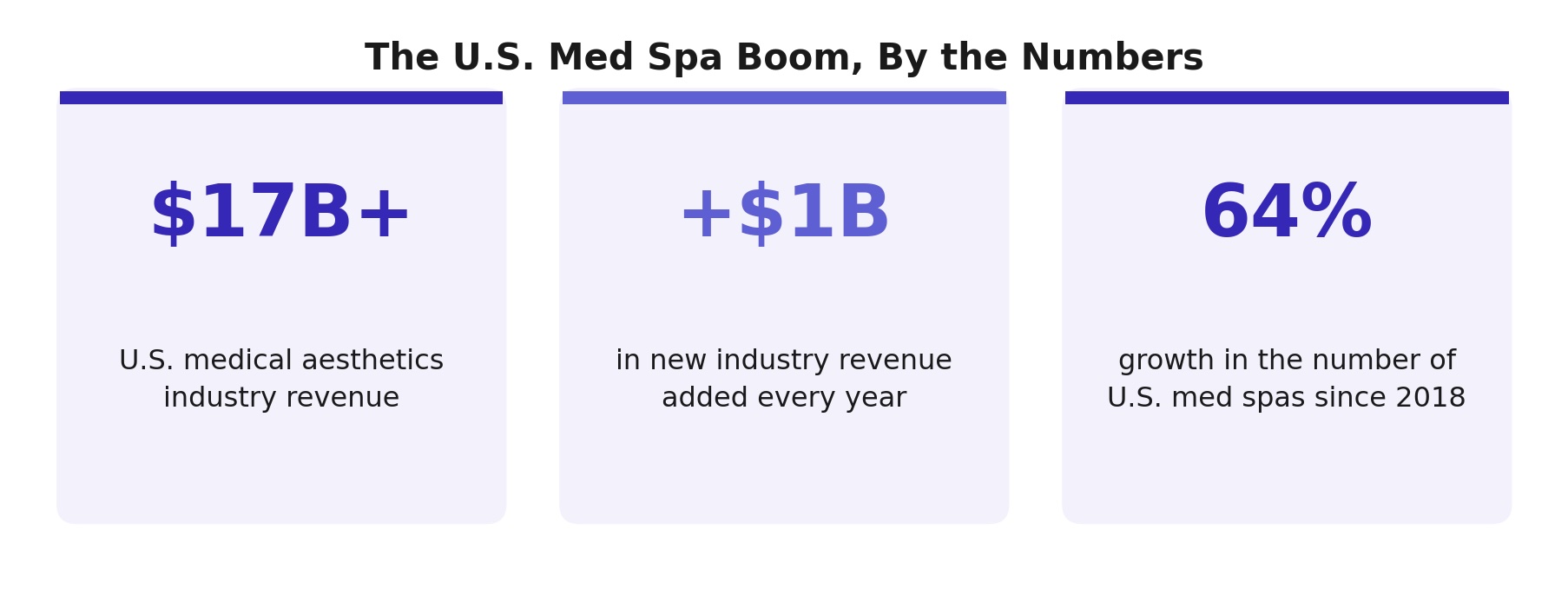
The reason this matters more now than it did five years ago is scale. According to the American Med Spa Association, the U.S. medical aesthetics industry has surpassed $17 billion in revenue and is adding more than $1 billion annually. A compilation of AmSpa's own State of the Industry research puts the growth in the number of U.S. med spas at roughly two-thirds since 2018. That is not a niche wellness trend. That is an industry adding the equivalent of a mid-size metro's worth of new locations every year, and every one of them needs booking, billing, and charting systems that actually talk to each other.
Texas sits near the center of that growth. Industry coverage of the med spa market puts Texas as the country's second-largest med spa market, with Dallas singled out as the state's single most competitive local market, thanks to a dense, affluent, appearance-conscious patient base. Competitive is good for patients. It is unforgiving for owners running three locations on a shared login and a spreadsheet held together by good intentions.
What IT Actually Means Once You Have More Than One Location
For a single-location med spa, IT is mostly a Wi-Fi router and a prayer. For a multi-location practice, it becomes an actual system: a booking platform that shares one real-time calendar instead of three disconnected ones, a point-of-sale environment that reconciles automatically instead of at 11 p.m. on close-out night, a charting system that treats before-and-after photography and consent forms as the protected health information they legally are, and a network that keeps energy devices, laser equipment, and payment terminals online during your busiest hour, not just your quietest one.
None of that is exotic. All of it is invisible until it breaks, and it has a habit of breaking during your best week, not your worst one.
The Cost of a Bad Wi-Fi Day
A single treatment room sitting idle for ninety minutes because a booking system crashed is real revenue that is not coming back. Multiply that across three locations and a handful of bad weeks a year, and the money spent avoiding it starts to look less like an expense and more like insurance with a far better track record than most insurance actually has.
There is also a quieter cost: the owner's own time. An owner troubleshooting a frozen POS terminal between injections is not exercising hands-on control of their business. They are losing an hour they will never get back, usually while a waiting room fills up and a front desk coordinator apologizes on their behalf.
Who Actually Owns This Problem Right Now?
At most growing med spas, IT ownership defaults to whoever on staff is least intimidated by a router, often the practice manager or the owner's spouse. That works fine right up until that person goes on vacation, or leaves the practice entirely, taking institutional knowledge of every password and vendor login with them. Access management across locations, who can see which patient records, which staff logins get shut off the day someone leaves, which devices are still connected to the guest Wi-Fi from two employees ago, is not a glamorous problem. It is also not one that fixes itself as a practice adds locations. It compounds.
What to Look for in a Med Spa IT Partner
Not every managed IT provider has actually worked inside a multi-location aesthetic practice, and it shows. The ones worth hiring understand booking, POS, and EMR-lite charting well enough to make them work together instead of around each other. They understand that before-and-after photography and consent documentation carry real compliance weight, not just marketing value. They can support the energy devices and laser equipment that increasingly run on the same network as everything else. And critically, they answer the phone during business hours, when an injector is mid-treatment and the front desk tablet just froze, not just through an after-hours ticket queue.
It also helps if they have opinions. A good med spa IT partner should be able to tell you, unprompted, why a shared front-desk login across three locations is a liability, why your Wi-Fi guest network probably shouldn't be one flat network with your payment terminals, and why "we'll deal with it when we open location three" is exactly backwards. If your current provider's answer to every question is "sure, we can look into that," that is not a partner. That is a ticket queue with a logo.
The Sub-Par Patient Experience
Patients notice more than owners assume. A booking confirmation that never arrives, a front desk iPad that needs restarting mid check-in, a payment terminal that declines a card twice before it works: none of these are dramatic failures, but they are the kind of small friction that shows up in reviews and in whether a patient rebooks. In a market where Dallas is already flagged as Texas's most competitive med spa market, a frustrated patient rarely has to look far for another option. Reliable systems are not a back-office concern. They are part of the treatment experience, whether anyone budgets for them that way or not.
Outsourcing IT Isn't Giving Up Control. It's Buying It Back.
The instinct to keep IT in-house, or to keep patching it together internally, usually comes from a good place: owners want control over something this central to the patient experience. In practice, the opposite tends to happen. A managed IT partner that understands healthcare-adjacent aesthetic practices gives an owner that hour back, along with systems built to scale before the second and third locations open, not after they start causing problems. That is the actual argument for outsourcing early. Not fear. Just math.
We've written a deeper, more technical version of this conversation in MedSpa Growth: Scaling to Multiple Locations Without Losing Sight of Security, which is worth a read if you're already past location number one.
Where To Go From Here
DFW's med spa market is not slowing down, and neither is the list of systems a growing practice depends on to run smoothly. The owners who treat IT like infrastructure, not an afterthought, are the ones who get to spend their energy on patients instead of point-of-sale terminals. If you're opening a second location, or you already have three and the shared-login situation has gotten out of hand, schedule a strategy session with our Dallas-Fort Worth team and let's build the systems before you need them, not after.
About the Author
Team Techvera
Techvera Team
Articles written collaboratively by the Techvera team, combining expertise across cybersecurity, managed services, and digital transformation.