
DFW urgent care clinics do not get caught off guard by flu season. They get caught off guard by their own budget. A clinic that comfortably handles 70 patients a day in July can be pushing 130 by January, and every system built around the July number starts to strain: the network, the EHR, the check-in kiosk, the phone line nobody has upgraded since 2019. According to Health Care Cost Institute research, respiratory illness makes up as little as 23 percent of urgent care visits in the middle of summer and as much as 58 percent at the peak of winter. That swing is large enough to turn a quiet Tuesday into a full parking lot.
None of this arrives without warning. Texas DSHS publishes a weekly respiratory virus surveillance report tracking exactly this pattern in real time, and this past season Children's Health in Dallas described it as its worst flu season in two decades, according to NBC 5 DFW reporting, with Texas among more than two dozen states the CDC flagged for very high flu activity that season. The data is public months before the waiting room fills up. The budget conversation usually happens after.
The Surge Is Predictable. The Budget Rarely Is.
Hospitals and health systems build surge capacity into their operating plans because a bad flu season can shut down an ER. Urgent care operators, especially smaller independent groups and regional chains, tend to treat the same pattern as an operational headache to manage in the moment instead of a line item to plan for months out. That gap is understandable. Most urgent care IT budgets get built around average daily volume, because average daily volume is what shows up in last year's financials. Peak week volume does not show up until it happens, and by then it is a staffing problem, not a budget line.
The fix is simple: ask for the money in August, before the problem shows up in November. That is also exactly why most clinics do not do it. Nobody wants to defend a budget line for a crisis that has not happened yet, even when the crisis shows up on the same weeks every year.
What Breaks First When Volume Doubles
It is rarely one dramatic failure. It is four or five small ones happening at once. Network bandwidth gets consumed by more concurrent EHR sessions, more devices at check-in, and more clinicians pulling up imaging at the same time. The EHR itself slows down under concurrent load in a way that never showed up during summer testing, because summer testing never simulated summer-plus-double. Check-in kiosks and queue management systems, built to handle a trickle, choke on a line. Phone systems, still the primary way most patients find out how long the wait is, jam at exactly the moment a clinic most needs to answer them.
We wrote about how quickly this compounds in 10 Minutes of Downtime = 5 Lost Patients: a system slow enough to add ten minutes to check-in does not stop with the patient in line. It backs up everyone behind them. For a group running multiple DFW locations, the math gets worse, because a network built without proper segmentation lets one overloaded site's problems bleed into every other site on the same connection, the exact failure mode we cover in our network segmentation guide for multi-site physician groups.
A Capacity Budget That Fits on One Page
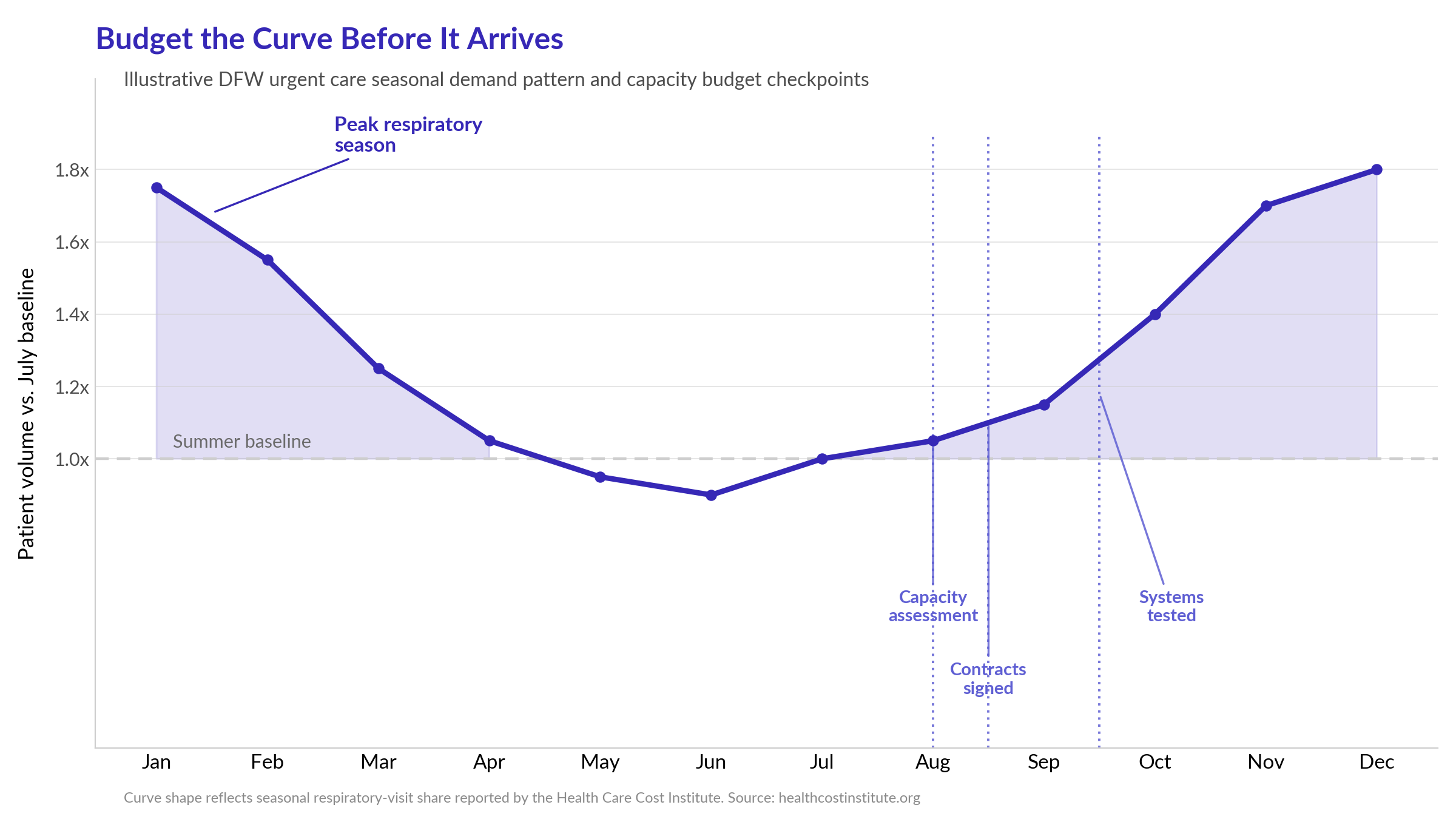
Skip the elaborate model. Pull your peak week from last winter and your slowest week from last summer, and look at the ratio between them. If peak week ran at 1.8 times your summer baseline, that ratio, not last year's average, is the number your network throughput, EHR concurrent-session limits, and check-in capacity need to clear. Padding the summer number by 10 percent isn't a capacity plan, it's a guess with a spreadsheet attached.
A vCIO conversation should be built around exactly this kind of number, not a generic technology refresh cycle. Our business intelligence and vCIO services exist for this specific gap: turning last year's actual peak-week data into next year's budget request, before the request becomes a scramble.
Put a Date on the Calendar, Not Just a Line Item
A budget without a deadline is a wish. Work backward from the point in the year when Texas respiratory visits typically start climbing, usually late October, and set three checkpoints: a network and EHR capacity assessment by late August, hardware, bandwidth, or staffing contracts signed by mid-September, and check-in systems and PRN staff access provisioned and tested by mid-October. The chart below lays out that seasonal pattern against a flat summer baseline, with each checkpoint marked against it.
The Compliance Bill That Comes With the Volume Bill
More patients also means more part-time and PRN staff getting system access on short notice, more devices moving through a waiting room that is suddenly twice as full, and an EHR audit log that needs to hold up to the same scrutiny at 150 patients a day as it does at 70. Volume does not suspend HIPAA. A packed waiting room is exactly the scenario regulators expect a practice to have planned for, not improvised. We go deeper on what that looks like operationally in HIPAA for the High-Volume Clinic.
Flu season is not going to stop showing up in October. The clinics that come out of it without a bad quarter are the ones that treated this year's peak week as next year's budget input, not next year's emergency. If your last capacity conversation happened in the middle of a bad week instead of before one, our healthcare IT team can help build the model before the season does it for you. Schedule a consultation and bring last winter's numbers.
Frequently Asked Questions
How much extra IT capacity should a DFW urgent care clinic budget for flu season?
Start with your own numbers, not an industry average. Compare last winter's peak week to last summer's slowest week. If that ratio was 1.7 or 1.8 times baseline, budget network, EHR, and check-in capacity to clear that number with headroom, not last year's annual average with a small buffer added on.
When should urgent care operators start budgeting for seasonal IT capacity?
By late August, based on the prior year's peak-week data. Contracts for any hardware, bandwidth, or staffing changes should be signed by mid-September, with systems tested and PRN staff provisioned by mid-October, ahead of the typical late-October climb in respiratory visits tracked by Texas DSHS.
What IT system usually fails first when urgent care patient volume spikes?
Network bandwidth and EHR concurrent-session limits tend to go first, followed closely by check-in kiosks and phone systems. All of them are built and tested around average daily volume, which is exactly the number that stops applying the moment flu season starts.
About the Author
Team Techvera
Techvera Team
Articles written collaboratively by the Techvera team, combining expertise across cybersecurity, managed services, and digital transformation.