
The demo looks great. A client logs in to your portal and asks why last quarter's statement shows a tax-loss harvest. An AI agent pulls the trade, explains it in plain English, and offers to book a call with their advisor. Then the vendor sends a per-seat quote, and the number looks manageable.
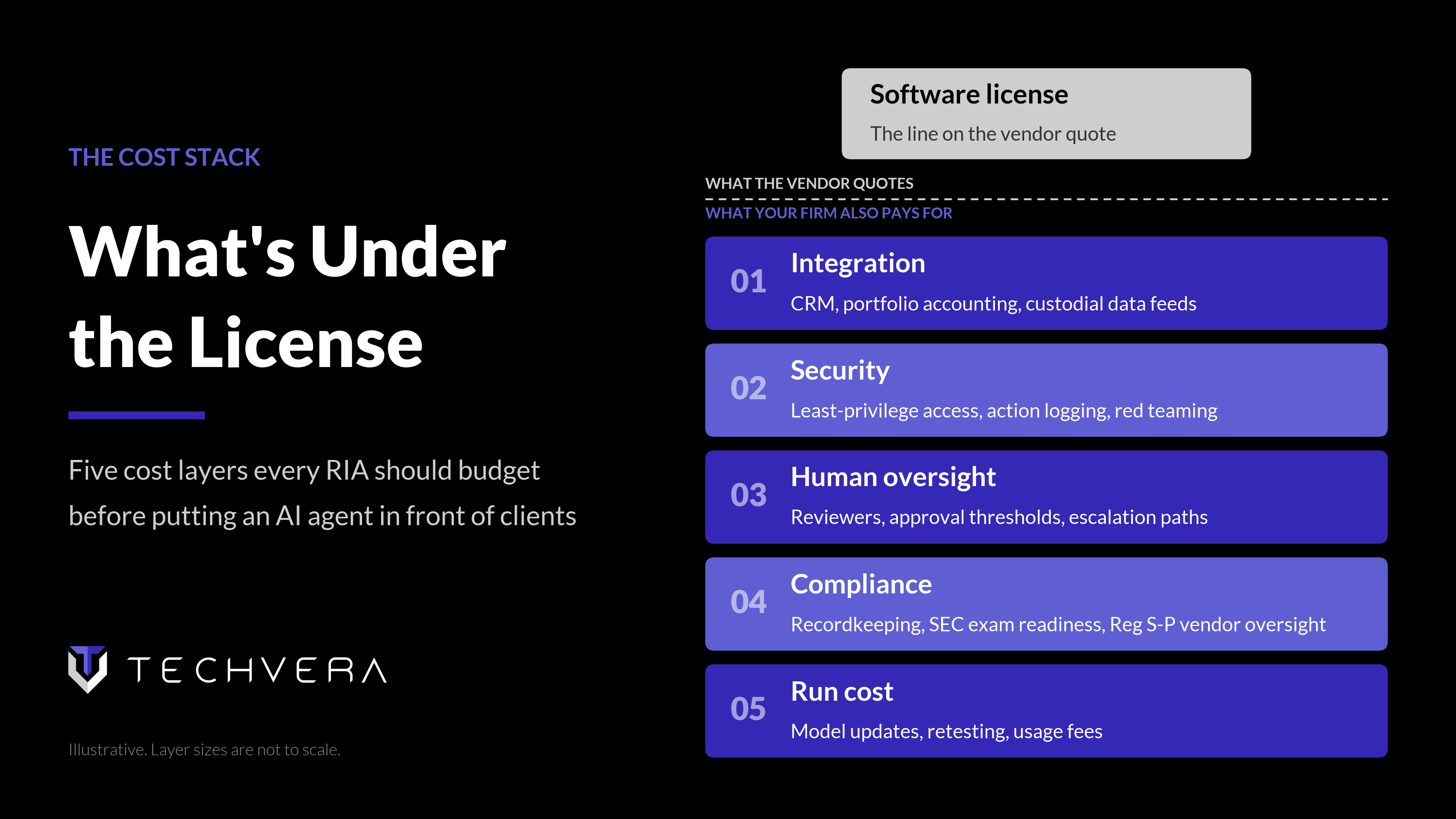
That quote is one line of the budget. An agent that talks to clients and acts on their data also needs integration work, security controls, human oversight, compliance recordkeeping, and ongoing monitoring before it goes anywhere near a client login.
The industry is early. Deloitte's 2026 outlook on agentic AI in wealth management, citing Orion survey data, reports that 73% of advisory firms use AI in some capacity, but only 6% use agentic tools. Among RIAs, the Charles Schwab 2026 RIA and AI Research Study of 533 firms found 63% use AI, mostly for notetaking and email drafting, and only about one in ten are fully integrating it into their business strategy. Meanwhile, Gartner predicts over 40% of agentic AI projects will be canceled by the end of 2027 due to escalating costs, unclear business value, or inadequate risk controls.
This post breaks the cost of a client-facing agent into five layers so RIA principals can budget for all of it before a contract starts the clock. It's October, so think of this as the part of the horror movie where someone finally turns on the basement light.
What Makes an AI Agent Different From a Chatbot
A chatbot answers questions. An agent takes actions. It reads account data, updates records, schedules meetings, or kicks off a workflow, often across several systems in one request. That ability is what makes agents useful, and it is also what makes them expensive to deploy safely.
Check the label before you buy. Gartner estimates that only about 130 of the thousands of vendors claiming agentic AI offer the real thing. It calls the rest agent washing, meaning existing chatbots and robotic process automation (RPA) tools rebranded for the moment. Some firms will pay agentic prices for a costume.
The production examples Deloitte highlights face advisors and staff. Morgan Stanley's AI Debrief summarizes meetings, generates follow-ups, and logs notes into the CRM. Raymond James launched its agent for select business units with explicit human-in-the-loop oversight. A client-facing agent carries more risk because no advisor reads its answer before the client does.
Layer One: Integration With the Systems You Already Run
To answer a client's question, an agent needs read access to your CRM, portfolio accounting platform, custodial data feeds, and document storage. To act on a request, it needs write access too. Each connection is its own project: API work, data mapping, testing, and a decision about what the agent is allowed to see.
A Gartner analyst warns that integrating agents into legacy systems can be technically complex, often disrupting workflows and requiring costly modifications. If your tech stack grew one bolt-on at a time, budget this layer accordingly.
Budget for integration and data mapping, a data access review, and testing against real client scenarios before launch.
Layer Two: Security for Software That Can Take Action
The OWASP Top 10 for LLM Applications ranks prompt injection as the top risk. It occurs when user prompts alter a model's behavior or output in unintended ways. Sixth on the list is excessive agency, which OWASP defines as the vulnerability that enables damaging actions in response to unexpected, ambiguous, or manipulated outputs. OWASP traces it to excessive functionality, excessive permissions, and excessive autonomy.
For a client-facing agent, that means a client, or someone who has taken over a client's account, can type something that pushes the agent past its intended limits. An agent with broad permissions is the horror-movie character who hears a noise and heads into the basement alone. OWASP's recommended control is to require a human to approve high-impact actions before they happen.
The gap is common. In IBM's 2025 Cost of a Data Breach Report, 97% of organizations that experienced an AI-related security incident said they lacked proper AI access controls.
Budget for scoped, least-privilege identities for the agent, logging of every action it takes, monitoring and alerting, and adversarial testing (red teaming) before launch and after major changes.
Layer Three: Human Oversight, Paid for in Staff Hours
FINRA's 2026 Annual Regulatory Oversight Report includes a section on AI agents. The risks it lists include agents acting autonomously without human validation, acting beyond their intended scope and authority, and running multi-step reasoning that makes outcomes difficult to trace or explain. FINRA oversees broker-dealers, so dual registrants should treat the report as direct guidance. For a standalone RIA, it is a useful preview of what regulators consider reasonable supervision.
FINRA asks firms to consider where to place human-in-the-loop oversight and how to track agent actions and decisions. Every checkpoint costs someone's time. A person reviews flagged conversations, approves actions above a set threshold, and takes over when the agent reaches a question it should not answer. That labor rarely appears in a vendor quote, and it continues after launch.
Budget for named reviewers, a documented escalation path, and weekly time for exception review.
Layer Four: Compliance, Recordkeeping, and Vendor Oversight
Nothing haunts a chief compliance officer like a client conversation nobody saved. Under SEC Rule 204-2, advisers must keep written communications relating to any recommendation or advice for at least five years. If your agent discusses a client's portfolio, plan to treat those transcripts as books and records, and confirm the details with counsel. That means exporting them to your archiving system in a format you control.
The SEC's fiscal year 2026 examination priorities say examiners will review the accuracy of firms' representations about their AI capabilities and whether firms have policies and procedures to monitor and supervise their use of AI. For automated investment tools, examiners will check whether algorithms lead to advice consistent with investors' profiles. If your marketing calls the agent a personal financial assistant, your controls need to support that description. Our guide to building an AI governance policy that holds up in an SEC exam covers the written side.
Then there's Regulation S-P. RIAs with less than $1.5 billion in assets under management had to comply with the amended rule by June 3, 2026, according to Davis Wright Tremaine. The SEC's fact sheet requires an incident response program, customer notification no later than 30 days after a firm becomes aware of unauthorized access to customer information, and oversight of service providers through due diligence and monitoring. Service providers must notify the firm within 72 hours of a breach involving customer information. An agent vendor that handles client data belongs in that oversight program, and its contract should reflect the 72-hour clock. We walk through the policy updates in what every RIA must update for the Reg S-P deadline.
Budget for archiving integration, updated written policies, vendor due diligence, contract review, and an incident response plan that covers the agent.
Layer Five: The Cost of Keeping It Running
After launch come model updates that can change how the agent behaves, retesting after each update, annual vendor reviews, and usage fees. Usage-based pricing is the candy bowl on the porch with a Please Take One sign. It works fine until a busy week empties it. Ask the vendor whether you pay per seat, per conversation, or per action, and set spending limits.
Budget for regression testing, usage caps and alerts, and a quarterly review of what the agent did and what it cost.
Why Most RIAs Should Start Advisor-Side
Deloitte's model describes three stages of adoption: AI as an assistive tool, embedded copilots with governance, and AI-native workflows. It projects productivity uplift of roughly 32% by 2032 for firms at the early, assistive stage. That gain comes without putting an agent in front of a single client.
Advisor-facing agents come with oversight built in, because an advisor reads the output before a client does. That gives your firm time to build the integration, security, logging, and policies from the layers above on lower-risk workflows. Once those controls work internally, extending them to clients becomes an expansion of a working program.
Starting internally also closes a gap many firms already have. Schwab found RIAs adopt AI most often through individual experimentation rather than firm-wide systems, and IBM found 63% of the organizations it studied had no AI governance policies. An advisor-side program gives that experimentation structure and a paper trail.
Questions to Ask Before You Sign
What actions can the agent take without a human approving them?
Which systems does it access, and with what permissions?
Where are conversation logs stored, and can we export them to our archive?
Will the vendor commit in writing to notify us within 72 hours of a breach involving customer information?
How will we know when the underlying model changes, and who retests it?
Who at our firm reviews flagged conversations, and how many hours a week will that take?
If a vendor cannot answer the first two in plain language, pause the deal until they can.
How Techvera Helps RIAs Deploy AI With the Right Controls
Techvera works with wealth management firms on the parts of this stack a software vendor does not cover. Our Managed AI team scopes use cases, connects agents to the systems you already run, and sets permissions before anything goes live. Our Cybersecurity team handles access controls, logging, and monitoring. Compliance Readiness maps the deployment to your SEC obligations, and vCIO Services turn the whole plan into a budget and roadmap your partners can approve.
See how we helped a wealth management firm strengthen its security posture. For related reading, see the AI risk question every RIA compliance officer will face in 2026, along with our guides to business continuity planning for RIAs and how IT compliance differs for broker-dealers and RIAs. You can find more on our financial services page.
Ready to price your stack before the vendor does it for you? Schedule your strategy session with no obligation at the end.
Frequently Asked Questions
What is agentic AI in wealth management?
Agentic AI refers to AI systems that take actions on a user's behalf, such as retrieving account data, updating records, or scheduling meetings, in addition to answering questions. According to Deloitte, current production examples in wealth management are mostly advisor-facing, such as meeting summaries, follow-ups, and CRM updates.
How much does it cost an RIA to deploy a client-facing AI agent?
Techvera has not found a reliable, vendor-neutral public benchmark for RIA-scale deployments. The total cost includes the software license plus integration, security controls, human oversight, compliance recordkeeping, and ongoing monitoring. Gartner predicts over 40% of agentic AI projects will be canceled by the end of 2027, with escalating costs among the reasons.
Do SEC rules apply to AI agents that communicate with clients?
Existing SEC rules apply to the firm using the agent. Rule 204-2 requires advisers to keep written communications relating to advice for five years, the SEC's 2026 examination priorities include AI representations and supervision, and amended Regulation S-P requires oversight of service providers that handle customer information.
About the Author
Team Techvera
Techvera Team
Articles written collaboratively by the Techvera team, combining expertise across cybersecurity, managed services, and digital transformation.